Why Supplements Still Feel Stuck in the 1950s
Walk down the wellness aisle of almost any major retailer today, and you are met with an overwhelming wall of isolation



For years, supplement marketing has followed a familiar script:
Long ingredient lists that make more look like better.
Impressive dose numbers displayed prominently on packaging.
Proprietary blends that reveal a total weight but conceal individual ingredient amounts.
Words like “clinically inspired,” “superfood,” and “natural” without much explanation of what they actually mean.
And when someone asks why a product costs more, the answer is often a discount code.
That approach assumes consumers will be persuaded by what appears on the front of the package.
But more shoppers are turning the package around.
They’re reading Supplement Facts panels, comparing ingredient forms and quantities, and asking questions that attractive packaging alone cannot answer.
At More. Longevity & Wellbeing, we believe that’s a positive change.
We built our approach around a simple principle: consumers deserve to understand not only what’s in a supplement, but why it’s there.
Recent research suggests that transparency is becoming an increasingly important purchasing consideration.
According to The Vitamin Shoppe’s 2026 Health & Wellness Trend Report, 47% of surveyed U.S. adults reported deciding against a supplement purchase because its label or formula lacked sufficient transparency.
A YouGov survey conducted for iHerb found that 73% of U.S. supplement buyers wanted complete information about ingredient sourcing and quality testing, while more than four in ten expressed willingness to pay more for it.
And in the Council for Responsible Nutrition’s 2026 Consumer Survey, 77% of adults said stronger enforcement against illegal, contaminated, or misleading products would increase their confidence in supplements.
These findings don’t mean every shopper evaluates products the same way. But they highlight a growing expectation:
Show us what’s inside. Explain why it matters. Give us a reason to trust it.
A proprietary blend reveals the combined weight of several ingredients without disclosing their individual quantities.
An ingredient appearing at the end of a blend may be present in a very small amount.
Without knowing how much of each ingredient is included, meaningful comparisons become difficult.
Transparency begins with quantities, not just ingredient names.
Absolutely.
A label that simply says “mushroom” may not distinguish between fruiting-body extracts, mycelium grown on grain, and ordinary mushroom powders.
These materials can differ in composition and the compounds they provide.
The same applies to vitamins, minerals, and botanicals. Different forms may have different properties, including solubility, stability, and bioavailability.
A milligram measures mass. It doesn’t tell you everything about how an ingredient may be used by the body.
Serving size determines how much of each ingredient you receive.
A comprehensive formula combining botanical extracts, vitamins, minerals, and other functional ingredients may require more space than a product built around one active ingredient.
At More., our powdered formulations have different serving sizes reflecting their compositions:
Mushroom Superfood blends: 12 g per serving
Vitality Blend: 10 g per serving
Relax Calming Blend: 8.5 g per serving
These serving sizes accommodate different combinations of ingredients selected for their intended functions.
The meaningful comparison isn’t simply scoop size. It’s what each serving provides, in what form, and for what purpose.
A meaningful serving delivers a thoughtfully designed formula, not just an impressive number on the package.
Not necessarily.
Nutrients and botanical compounds have different functions, and their effects depend on factors including dose, chemical form, absorption, and individual circumstances.
Some nutrients also interact with one another, sometimes supporting and sometimes competing for absorption.
A thoughtful formulation considers ingredient quantities and their complementary roles rather than relying on the largest possible numbers.
More isn’t automatically better. Formulation matters.
Why does this product cost more?
Why was one ingredient form chosen over another?
What quality testing is performed?
What is the formula intended to support, and what are its limitations?
A brand should be willing to explain its decisions clearly, distinguish evidence from marketing language, and acknowledge what it cannot promise.
A confident answer is more valuable than an impressive slogan.
Transparency is where our approach begins, not where it ends.
At More., we consider ingredient forms, quantities, intended physiological functions, and how ingredients complement one another within the complete formula.
A supplement should be evaluated as a formulation, not simply a collection of impressive numbers.
We disclose the quantities of our dietary ingredients rather than hiding them behind combined proprietary blend weights.
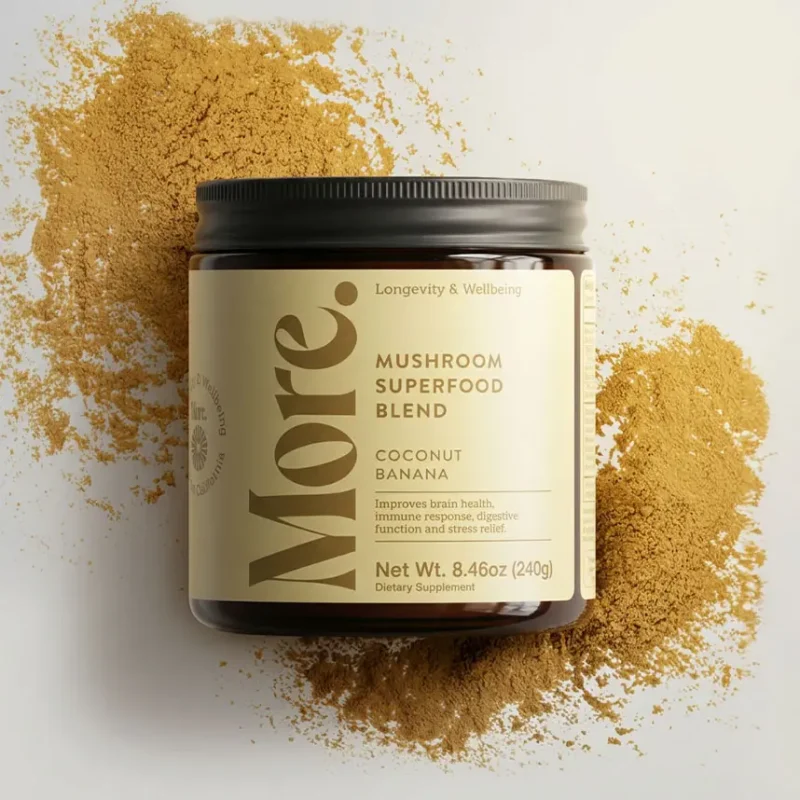
For example, each 12 g serving of our Mushroom Coffee Superfood blends provides:
700 mg of seven organic fruiting-body mushroom extracts, with 100 mg of each extract
300 mg ashwagandha
100 mg Panax ginseng
70 mg turmeric extract
5 g prebiotic inulin fiber
These ingredients serve different intended functions within the formulation. Their inclusion reflects complementary roles, not simply an effort to make the ingredient list longer.
Our mushroom blends contain seven organic fruiting-body extracts: Lion’s Mane, Reishi, Chaga, Cordyceps, Turkey Tail, Maitake, and Shiitake.
We don’t use mycelium grown on grain.
Each extract is identified, and its individual quantity is disclosed.
We select dietary ingredients based on their intended roles, forms, quantities, and contributions to the overall formula.
We also explain the purpose of other formulation components, including organic rice flour and acacia gum when used as manufacturing aids.
Consumers should understand both the ingredients selected for their intended benefits and those included for practical formulation purposes.
Our formulation standards also guide what we exclude.
We don’t use magnesium stearate, magnesium oxide, silicon dioxide, or titanium dioxide.
These are deliberate formulation preferences, not claims that every excluded ingredient is inherently unsafe.
We prefer explaining our decisions over using fear to sell.
Our supplements are manufactured in the United States at a GMP-certified facility operating under FDA dietary supplement regulations, 21 CFR Part 111.
Finished-product testing is conducted through ISO 17025-accredited laboratories, including testing for heavy metals and microbial contaminants.
Quality depends on manufacturing controls, ingredient verification, appropriate testing, and documented procedures, not simply reassuring words on a label.
Our product pages provide Supplement Facts panels, ingredient information, serving directions, and relevant cautions.
We believe consumers should be able to review this information before making a purchasing decision.
Our Why More. page addresses questions consumers may reasonably ask:
Why choose More. when other supplements cost less?
Why trust a newer brand?
Are you paying for formulation quality or attractive packaging?
Our product-specific FAQs go further.
Our Bone Support FAQ discusses calcium and arterial calcification. Our Liver Detox Blend FAQ explains the distinction between normal liver function and popular detox claims. Our Menopause Support FAQ addresses whether the formulation contains hormones.
These aren’t always easy questions, but they’re worth answering.
Transparency means more than showing an ingredient list. It means being willing to explain the decisions behind it.
Show the amounts.
Explain the forms.
Share the testing.
Answer the hard questions.
Respect the person reading the label.
The supplement industry doesn’t need more complicated promises. It needs clearer information, meaningful comparisons, and greater accountability for the claims brands make.
Consumers shouldn’t have to become formulation experts to understand what they’re buying.
At More., we believe the responsibility belongs with the brand to make information accessible, explain its decisions, and be clear about both the purpose and limitations of its products.
Because a well-informed customer isn’t a challenge to a good formulation.
It’s exactly who that formulation should be built for.
That’s what More. is for.





©2026 More longevity & Wellbeing

Merchandise manufactured in a facility that
complies with good manufacturing practices
Merchandise manufactured in a facility that
complies with good manufacturing practices