Why Supplements Still Feel Stuck in the 1950s
Walk down the wellness aisle of almost any major retailer today, and you are met with an overwhelming wall of isolation



The gut and the brain are in constant communication.
• Through the nervous system.
• Through chemical signaling.
• Through the microbiome.
This connection is often called the gut–brain axis, but it’s less of a pathway and more of a loop.
Signals travel both ways.
Continuously.
Sometimes the shift starts with stress.
You feel pressure.
Your body responds.
Digestion slows.
The gut becomes more sensitive.
Discomfort appears without a clear physical cause.
This is not imagined.
It’s a physiological response to a system that has moved into a state of alert.
Other times, the signal starts in the body.
Digestion feels off.
Bloating becomes frequent.
Certain foods no longer sit the same.
And alongside it, something else appears.
• Low mood.
• Restlessness.
• Anxiety that feels untethered from cause.
Because in many cases, it isn’t starting in the mind.
It’s emerging from the body.
The real question isn’t whether it’s the gut or the mind.
It’s why the system isn’t stabilizing.
Because once the loop begins, each side reinforces the other.
Stress changes digestion.
Changes in digestion affect mood.
And over time, the distinction becomes less meaningful.
You don’t experience it as two issues.
You experience it as one state.
Patterns still matter.
When symptoms rise and fall with stress, the nervous system is often leading.
When symptoms persist regardless of context, the gut may be driving more of the signal.
But these are tendencies, not rules.
The body rarely operates in isolation.
Trying to separate the two often leads to partial solutions.
Calming the mind without supporting the body can feel temporary.
Supporting digestion without addressing stress can feel incomplete.
The system needs coherence.
That means supporting how the nervous system responds, how the gut environment functions, and how nutrients are absorbed and communicated across the body.
Not as isolated interventions.
But as parts of the same conversation.
This perspective is not new. Systems like Ayurveda have long viewed digestion, mood, and resilience as interconnected expressions of the same underlying balance.
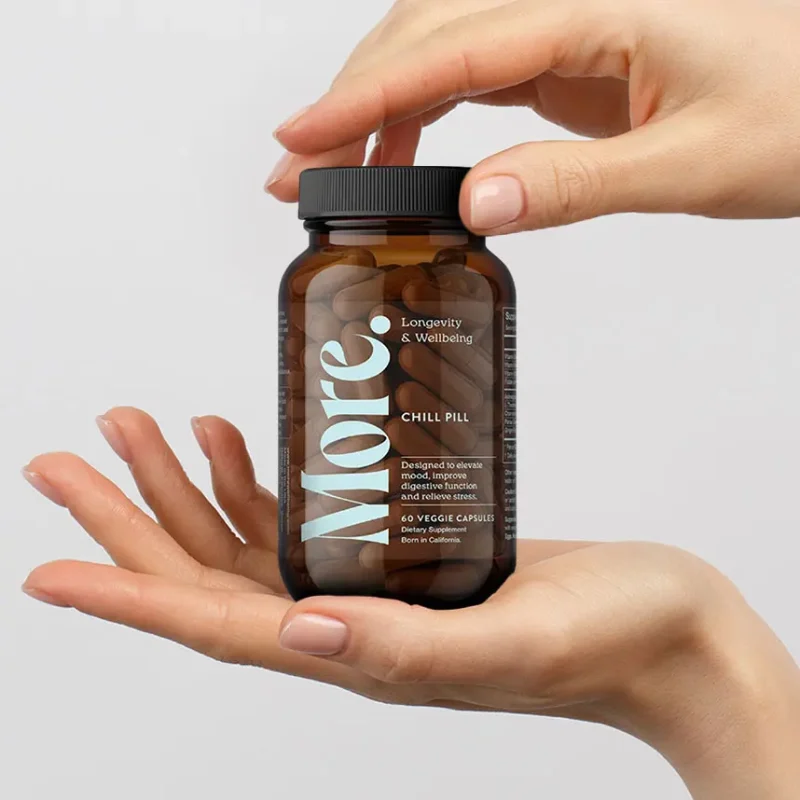
At More., gut health and mood are not treated as separate categories.
Because the body doesn’t experience them that way.
Each formulation is built to support multiple systems at once
not to isolate a single symptom.
That means considering how the nervous system responds to stress, how the gut environment influences signaling, and how nutrients are absorbed and used across systems.
Not more ingredients for the sake of complexity.
Not higher doses to force an effect.
But combinations designed to work together,
in a way the body can integrate and build on over time.
This is why some formulas may support both calm and digestion.
Or energy and stress resilience.
Because in the body, those functions are already connected.
The goal is not to override the system.
It’s to support it so it can regulate more effectively on its own.
Instead of asking:
“What should I take for anxiety?”
or
“What should I take for gut issues?”
A more useful question becomes:
“What does my system need more support with right now?”
That shift changes everything.
Because it moves away from chasing symptoms
and toward supporting how the body actually functions.
When the system has more support, the changes tend to feel less like relief and more like stability.
• Less reactive.
• More steady.|
• Less like managing symptoms.
• More like the body returning to baseline.
• Not forced.
• Not immediate.
• But consistent.
If you’ve been trying to figure out whether your gut is affecting your anxiety, or your anxiety is affecting your gut, you’re asking a reasonable question.
Just not the most useful one.
Because the body is not choosing between the two.
It’s responding as a whole.
This is also why More. is built the way it is.
Not around isolated claims, but around how the body actually works.





©2026 More longevity & Wellbeing

Merchandise manufactured in a facility that
complies with good manufacturing practices

Merchandise manufactured in a facility that
complies with good manufacturing practices