Why Supplements Still Feel Stuck in the 1950s
Walk down the wellness aisle of almost any major retailer today, and you are met with an overwhelming wall of isolation



These terms matter. But on their own, they do not tell the full story.
At More., we believe mushroom quality should be easier to understand. This guide breaks down what mushroom supplement labels do not always explain—and what to actually look for when choosing a mushroom blend.
One of the first things to look for on mushroom supplement labels is whether a product uses fruiting body extracts or mycelium-on-grain.
The fruiting body is the visible part of the mushroom, traditionally used in many preparations.
Mycelium is the root-like network. Some supplements use mycelium grown on grain, then process the entire material together, which can include both fungal material and residual grain.
At More., we use fruiting body mushroom extracts and do not use mycelium-on-grain ingredients.
Beta-glucans are naturally occurring compounds found in mushrooms and are often used as a quality marker.
But a single number does not explain everything.
Levels can vary depending on testing method, mushroom species, and supplier. A higher percentage does not automatically reflect how a finished formula performs as a whole.
At More., we do not define quality by a single metric. Our approach considers overall extract integrity, purity, consistency, and how the ingredients function together within the blend.
You may see mushroom supplements labeled as 10:1, 20:1, or higher.
These ratios can sound powerful, but they are not standardized across suppliers. A 10:1 extract from one source is not necessarily comparable to another.
The ratio alone does not explain what remains in the final extract or how it functions within a complete formula.
At More., we select ingredients based on quality, consistency, and how they perform within the full blend, not on ratio claims alone.
Standardization adjusts an ingredient to contain a specific compound.
That can be useful. But mushrooms are naturally complex and contain a broader range of compounds, which is why we focus on full-spectrum mushroom extracts rather than isolated targets.
Mushroom supplement labels may tell you the species, but often not the supplier, handling, or batch consistency.
Those details matter.
We work with experienced suppliers and select ingredients based on defined quality standards, consistency, and overall extract integrity.
A mushroom supplement should not be judged by one number, one ratio, or one buzzword.
It should be evaluated based on how the formula comes together.
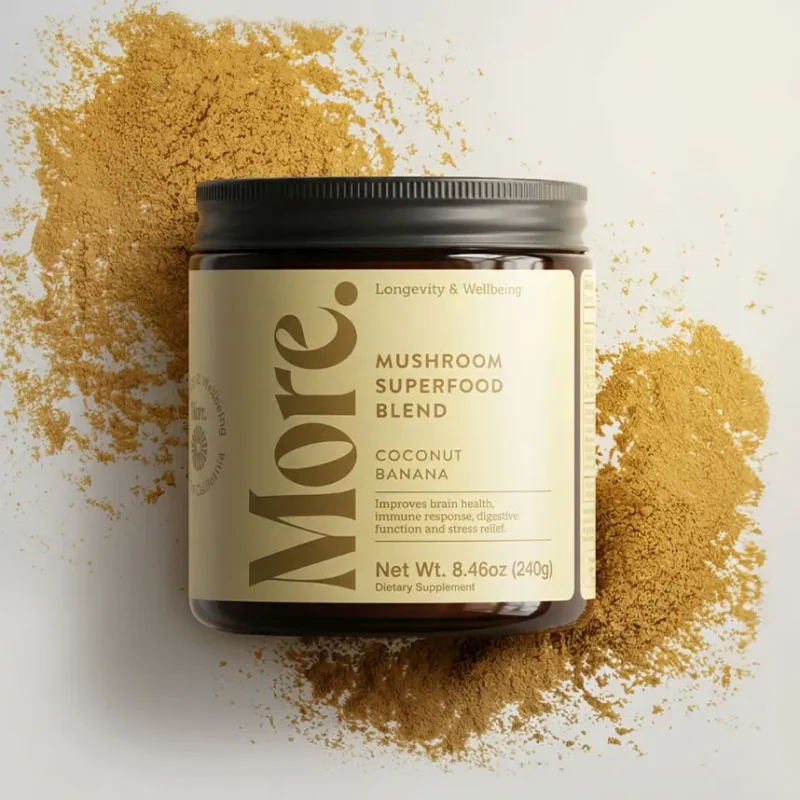
This is the approach behind our Mushroom Superfood Blends: each ingredient is selected not in isolation, but for the balance of the whole.
The goal is not to chase a single impressive claim.
The goal is to create a functional, balanced formula that fits into real life.
When choosing a mushroom supplement, ask:
• Does it use fruiting body extracts?
• Does it avoid mycelium-on-grain?
• Does the brand explain its testing standards?
• Is the focus on one number, or the full quality picture?
• Does the formula make sense as a whole?
Mushroom supplement quality is not just what is printed on the front of the label.
It is sourcing, ingredient quality, testing, formulation, and transparency.
At More., clarity is part of quality.
Because what you take should make sense.
For educational purposes only. Not medical advice.





©2026 More longevity & Wellbeing

Merchandise manufactured in a facility that
complies with good manufacturing practices
Merchandise manufactured in a facility that
complies with good manufacturing practices