Why Supplements Still Feel Stuck in the 1950s
Walk down the wellness aisle of almost any major retailer today, and you are met with an overwhelming wall of isolation


You can lose bone around your teeth without realizing it.
We spend years thinking about cavities, enamel, whitening, and gum health. We brush, floss, and visit the dentist.
But how often do we think about the bone holding our teeth in place?
When we hear “bone health,” we think about our spine, hips, and osteoporosis as we age.
Rarely do we think about our mouths.
Yet the jawbone is part of our skeleton, and the structures supporting our teeth depend on many of the same biological processes involved in maintaining healthy bones.
Your teeth aren’t bones. But the bone supporting them matters more than you might realize.
Tooth enamel is the hardest substance in the human body.
Its strength comes largely from hydroxyapatite, a crystalline mineral composed of calcium and phosphate.
Enamel protects the structures beneath it and helps teeth withstand the daily forces of biting and chewing.
But enamel has an important limitation.
Unlike bone, lost enamel cannot grow back.
Bone is living tissue that continually renews itself. Mature enamel lacks the cells needed to regenerate its original structure.
Early mineral loss can sometimes be reversed through remineralization, supported by saliva, fluoride, and appropriate dental care. But once enamel has been physically lost, the body cannot simply rebuild it.
This is why protecting enamel matters.
It’s also why healthy teeth require more than strong enamel.
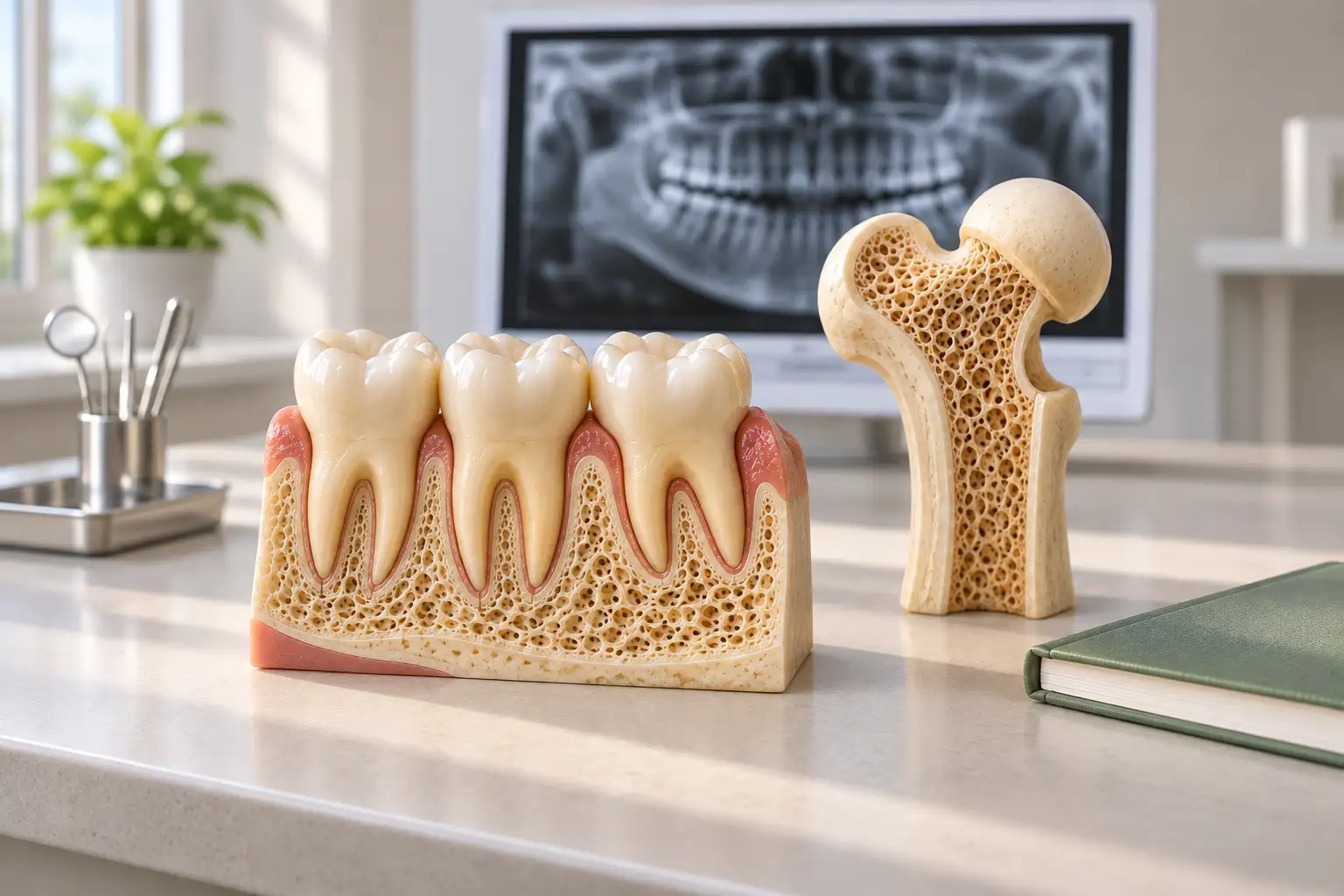
Every natural tooth is anchored within a specialized part of the jawbone called the alveolar bone.
A periodontal ligament connects the tooth root to the surrounding bone, helping stabilize the tooth and absorb chewing forces.
Together with the gums and other supporting tissues, these structures keep teeth securely in place.
But this support system can change.
Periodontal disease can damage the tissues and bone surrounding teeth. Tooth loss can also lead to gradual jawbone shrinkage as the area receives less mechanical stimulation.
The visible tooth is only part of the story. What holds it in place deserves attention, too.
Like the rest of your skeleton, the jawbone is living tissue that undergoes continuous remodeling.
As we age, maintaining bone mass becomes increasingly important. For women, bone loss can accelerate during and after menopause as estrogen levels decline.
Researchers have investigated associations between lower skeletal bone density, changes in the jawbone, and tooth loss.
But these relationships are complex.
Osteoporosis does not automatically cause tooth loss. Periodontal disease is a separate condition influenced by bacterial plaque, inflammation, oral hygiene, smoking, diabetes, and other factors.
Still, the connection highlights something worth remembering.
The jawbone belongs in the broader conversation about skeletal health.
What happens in the mouth should not always be considered independently of the rest of the body.
Calcium is the most abundant mineral in the human body.
Approximately 99% is stored in bones and teeth, where it contributes to their structure and hardness.
During tooth development, calcium is essential for forming mineralized dental tissues.
Throughout adulthood, adequate calcium intake helps maintain normal bones, including the jawbone.
But there is an important distinction.
Taking additional calcium does not mean the body will automatically deposit more calcium into existing tooth enamel.
Enamel remineralization primarily depends on conditions within the mouth, including saliva, fluoride, and the balance between mineral loss and replacement.
Dietary calcium supports a different, broader process: maintaining adequate calcium availability for normal physiological and skeletal functions.
Calcium matters. But how the body uses it matters just as much.
And calcium does not work alone.
Maintaining normal skeletal health involves several nutrients, each contributing to different biological processes.
Vitamin D supports calcium absorption.
Without adequate vitamin D, the body may absorb calcium less efficiently, even when dietary intake appears sufficient.
Magnesium contributes to normal bone structure.
It also participates in vitamin D metabolism and numerous cellular functions.
Vitamin K plays a role in bone metabolism.
It is required to activate proteins involved in bone mineralization, including osteocalcin. Although vitamin K2 has been studied for skeletal health, evidence that additional supplementation prevents fractures remains mixed.
Vitamin C supports normal collagen formation.
Collagen contributes to the structural framework of bone and connective tissues.
Zinc also participates in normal cellular processes involved in tissue maintenance.
These nutrients perform different functions, but all contribute to the larger picture of nutritional and skeletal health.
The goal isn’t to consume more of everything. It’s to understand what the body needs and why.
This is where expectations matter.
Adequate calcium and other essential nutrients contribute to normal skeletal health, and calcium is necessary for healthy tooth development.
But a bone-support supplement is not a dental treatment.
It cannot regrow destroyed enamel, reverse periodontal disease, or guarantee protection against tooth loss.
Brushing with fluoride toothpaste, cleaning between teeth, maintaining a balanced diet, and receiving regular dental care remain essential.
Food should generally be the foundation of nutritional intake.
When dietary intake is insufficient, appropriately selected supplements may help address nutritional gaps.
That decision should reflect individual needs rather than the assumption that higher doses always produce better results.
Good supplementation begins with understanding what the body needs, not simply adding more.
Meeting nutritional needs begins with food, but thoughtful supplementation can play a supporting role when appropriate.
At More. Longevity & Wellbeing, we apply that principle to how we formulate.
Rather than focusing on calcium alone, we considered the complementary nutrients involved in normal skeletal maintenance.
More. Bone Support combines microcrystalline hydroxyapatite calcium (MCHC) with magnesium, vitamin D3, vitamin K2, vitamin C, zinc, and other supporting nutrients.
Each ingredient has a defined nutritional purpose.
Calcium contributes to the maintenance of normal bones and teeth. Vitamin D supports calcium absorption. Magnesium and vitamin K participate in normal bone metabolism, while vitamin C supports collagen formation.
These are established physiological roles of the individual nutrients. They should not be interpreted as evidence that the finished formula has been clinically demonstrated to improve jawbone density, prevent tooth loss, or treat dental conditions.
Every dietary ingredient is named. Every amount is disclosed.
Because understanding a formula should not require guessing what’s inside it or why an ingredient was included.
The body doesn’t maintain bone through one nutrient acting alone. Neither should thoughtful formulation begin and end with one ingredient.
We tend to divide wellbeing into separate categories.
Dental health. Bone health. Nutrition. Aging.
But the body does not operate according to those categories.
The enamel protecting your teeth is different from the living bone anchoring them.
The nutrients involved in skeletal maintenance serve different roles from the daily oral care that protects enamel and gums.
The next time you think about calcium, consider more than your hips and spine.
Think about the jawbone supporting your teeth.
Think about the nutrients involved in maintaining normal skeletal structure.
And remember that caring for your smile involves more than what you can see in the mirror.
Healthy aging isn’t about focusing on one part of the body at a time. It’s about understanding how the pieces work together.
Choose You. Choose More.
Disclaimer: This article is for educational purposes only and does not replace professional medical or dental advice. More. Bone Support is not intended to treat dental disease, rebuild enamel, or prevent tooth loss.
These statements have not been evaluated by the Food and Drug Administration. This product is not intended to diagnose, treat, cure, or prevent any disease.





©2026 More longevity & Wellbeing

Merchandise manufactured in a facility that
complies with good manufacturing practices

Merchandise manufactured in a facility that
complies with good manufacturing practices