Why Supplements Still Feel Stuck in the 1950s
Walk down the wellness aisle of almost any major retailer today, and you are met with an overwhelming wall of isolation



Vitamin D helps the intestine absorb calcium. But that calcium does not arrive in the body with a private destination.
It enters a process influenced by magnesium, parathyroid hormone, the kidneys, vitamin K-dependent proteins, physical activity, and the ongoing work of bone cells.
No nutrient gets its own lane.
The body works through coordination. Nutrients share pathways. Organs exchange signals. One process can depend on several inputs arriving in the right form, in an appropriate amount, and at the right time.
That is where systems-based supplementation begins.
Not with the belief that more ingredients are automatically better. With the recognition that biological relationships matter.
Studying nutrients individually remains essential. It helps researchers identify deficiencies, establish biological functions, evaluate safety, and understand what a particular substance may do. But isolation is a research method, not how the body experiences nutrition. A micronutrient can have a dedicated role while also participating in broader metabolic networks across oxidative, inflammatory, and hormonal regulation.[1]
That context is why a large number on the front of a label cannot explain the complete formula. It does not show how the ingredient fits, what form it takes, or what else participates in the same process.
Bone is often reduced to calcium because calcium gives bone much of its mineral structure. The biology is broader.
Vitamin D supports calcium absorption and normal bone mineralization.[2] Magnesium contributes to bone structure and participates in processes involved in vitamin D metabolism.[3]
Vitamin K is required to activate proteins involved in normal bone metabolism, including osteocalcin.[4] Vitamin C contributes to normal collagen formation. Bone formulas may also include nutrients such as potassium, zinc, manganese, and boron, each present in its own form and amount.
None of this makes calcium unimportant. It makes calcium part of a larger story.
It also explains why the most useful question is rarely, “Which product has the biggest calcium number?” A better question is, “What does the complete formula recognize about the way bone is built and maintained?”
The experience of stress is also distributed across more than one pathway.
The brain interprets a demand. The autonomic nervous system changes alertness. Endocrine signals help mobilize energy. Muscles hold tension. Sleep influences how the next day is experienced. Nutritional status forms part of the background in which all of this occurs.
This is why “calm” cannot be fully explained by one neurotransmitter or one fashionable botanical.
Ashwagandha extracts have been studied for perceived stress, sleep, and cortisol-related outcomes. L-theanine has been investigated for stress-related measures and relaxed attention. Magnesium is involved in normal nerve and muscle function. Botanicals such as passionflower, lemon balm, and chamomile have different histories of traditional use and emerging research.
These are not interchangeable ingredients. Their proposed roles, evidence, studied doses, and time courses differ.
Looking at them through a systems lens does not mean declaring the combination proven. It means asking whether the ingredients contribute distinct and relevant forms of support rather than repeating the same mechanism under several names.
The gut-brain axis is not a wellness metaphor. The digestive tract and brain communicate through neural, immune, endocrine, and metabolic pathways.
The microbiome participates in that conversation by transforming components of the diet into compounds that can affect the intestinal environment and send signals beyond it. Sleep, stress, diet, medications, and the composition of the microbiome can all influence the exchange.
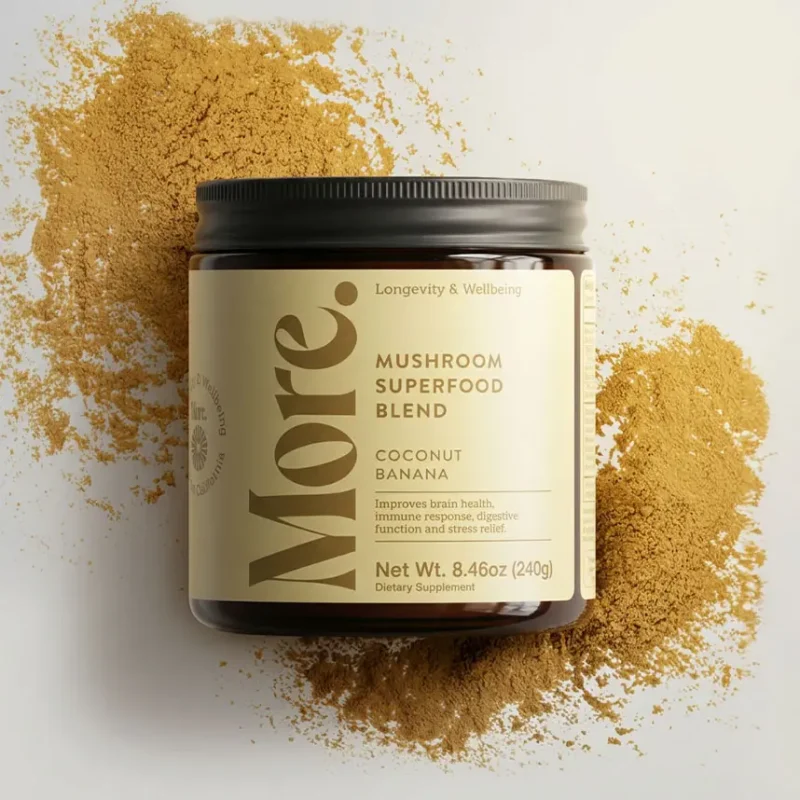
Functional mushrooms are being studied within this larger network. Research has explored several mushroom species in relation to cognition, mood, and other areas of health, but human findings are still developing and differ by species and formula.[5]
Research involving one mushroom species cannot automatically describe another species or a multi-mushroom formula.
The word “mushroom” alone therefore tells us very little. Naming each species, its amount, and the composition of the complete serving provides essential context.
The menopausal transition offers another example of interconnected biology.
Changes in ovarian hormones may occur alongside differences in temperature regulation, sleep, mood, concentration, body composition, and bone density. The experience varies considerably from one woman to another, and not every change during midlife is caused by menopause.[6]
That complexity is precisely why one symptom should not be asked to explain the whole transition.
A systems perspective considers the wider context. What has changed? Which experiences overlap? Which nutritional or botanical ingredients have relevant roles? Which symptoms deserve medical evaluation rather than being placed automatically under the menopause label?
This approach respects the transition without pretending that every woman needs the same answer.
The liver is often described as a filter that needs to be flushed. Its actual work is far more complex: it processes nutrients, produces bile, transforms many compounds, and contributes to the body’s own antioxidant systems.
That is why ingredients such as NAC, artichoke leaf extract, milk thistle extract, turmeric extract, dandelion root, and B vitamins should not be collapsed into one vague “detox” idea. Their roles differ. A systems perspective means nutritional support for normal liver function, not a cleanse.
Once the body is understood as a network, the label starts to look different.
The hero ingredient becomes only the beginning. The more revealing questions are:
What is the purpose of the complete formula?
Does each ingredient contribute something relevant to that purpose?
Are the roles complementary or merely repetitive?
Are vitamin and mineral forms identified, and are botanical parts or mushroom species named where the label provides that information?
Is every dietary ingredient amount disclosed?
Does the formula show restraint, or is the label crowded for appearance?
Does the language distinguish established functions from emerging research?
These questions do not require a consumer to become a biochemist. They require the brand to show its work.
“Systems-based” should not become another undefined phrase printed on the front of a bottle.
It should mean that a formula was built around a clear purpose. That ingredients were selected for distinct, relevant roles. That the label states what the product actually contains without suggesting details that have not been established. That amounts are visible. That no proprietary blend prevents the consumer from evaluating the complete serving.
It should also mean restraint.
More ingredients do not automatically create a more intelligent formula. True systems thinking includes knowing what belongs, what does not, and where the evidence ends.
Combination research remains limited across much of supplement science. Biological rationale can explain why ingredients were placed together, but it should not be turned into a guaranteed clinical outcome. That is the line between thoughtful formulation and marketing theater.
At More., that standard is the label itself: named ingredients, disclosed amounts, specified forms, no proprietary blends.
Because the body does not use nutrients one at a time.
1. van Ommen B, et al. “A network biology model of micronutrient related health.” British Journal of Nutrition. 2008;99(S3):S72-S80. https://doi.org/10.1017/S0007114508006922
2. National Institutes of Health, Office of Dietary Supplements. “Vitamin D: Fact Sheet for Health Professionals.” https://ods.od.nih.gov/factsheets/VitaminD-HealthProfessional/
3. National Institutes of Health, Office of Dietary Supplements. “Magnesium: Fact Sheet for Health Professionals.” https://ods.od.nih.gov/factsheets/Magnesium-HealthProfessional/
4. National Institutes of Health, Office of Dietary Supplements. “Vitamin K: Fact Sheet for Health Professionals.” https://ods.od.nih.gov/factsheets/VitaminK-HealthProfessional/
5. Cha S, et al. “A review of the effects of mushrooms on mood and neurocognitive health across the lifespan.” Neuroscience & Biobehavioral Reviews. 2024;158:105548. https://doi.org/10.1016/j.neubiorev.2024.105548
6. National Institute on Aging. “What Is Menopause?” https://www.nia.nih.gov/health/menopause/what-menopause
This article is for educational purposes only and is not intended as medical advice. Dietary supplements are not intended to diagnose, treat, cure, or prevent any disease. Consult a qualified healthcare professional before using a dietary supplement, particularly if you are pregnant, nursing, have a medical condition, or take medication.





©2026 More longevity & Wellbeing

Merchandise manufactured in a facility that
complies with good manufacturing practices

Merchandise manufactured in a facility that
complies with good manufacturing practices